Hump Day Hooch
It Must Be Love: A Mustang Prairie RomanceHump Day Hooch is a recurring Wednesday drinking gathering at Sadie and Dylan’s home, where conversation and alcohol create an informal social institution within Mustang Prairie. Its decisive significance lies less in the drinks than in the gathering’s function: it gives newcomers a route into friendship, gives established friends a space for collective disclosure, and places Trixie Beaumont’s uncertain relationship with Jack Thorpe under the affectionate scrutiny of the wider community.
Setting and Recurring Practice
Hump Day Hooch takes place on Wednesday evening, and Trixie Beaumont approaches it as a deliberate remedy for emotional strain. She needs both girl talk and alcohol, “and both in large quantities,” before collecting Honey and taking her along. Trixie explains that the group meets at least twice a week, sometimes more, and defines the custom plainly as talking, drinking, and catching up while people marry and have babies. The description makes the gathering part of Mustang Prairie’s ordinary social rhythm rather than a one-off celebration.
The event is hosted by Sadie and Dylan, whose home becomes temporarily open to a widening circle. Sadie supplies the hooch through a secret source and serves it in large jugs, later pouring it into appealing glass jars. The homemade, abundant presentation contrasts with the informality of the occasion: Hump Day Hooch has no formal program, but it has recognizable rituals, hosts, provisions, and expectations of participation.
Honey’s Introduction to the Circle
Trixie Beaumont brings Honey because settling in Mustang Prairie requires more than a residence. Trixie presents friendship as a communal obligation and invites Honey into the group with the practical assurance that it is time to make friends. Honey’s initial response is uncertainty; she asks what the women actually do, revealing that the gathering’s meaning is not self-evident to an outsider.
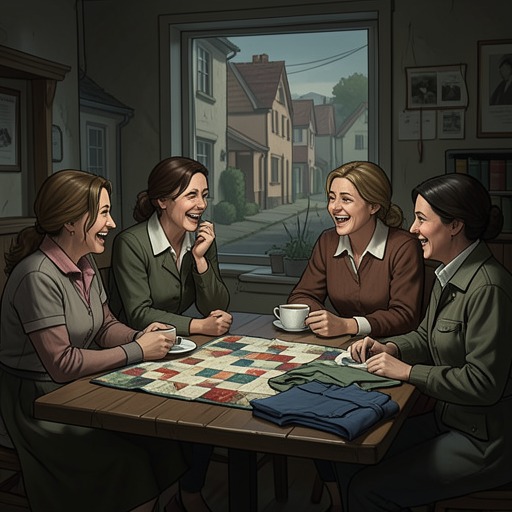
For several minutes, the room threatens to overwhelm Honey. The women’s voices are loud, their laughter louder, and several conversations occur at once. Trixie notices this without withdrawing from the group or treating Honey as fragile. Instead, she laughs with everyone while Honey slowly begins to open up. The gathering therefore performs two kinds of welcome at once: it is noisy and potentially intimidating, but its intimacy is made accessible through participation rather than ceremony.
A distinctive point of connection arrives when the women play the song Sadie recorded for Alex’s baby shower, a duet with Alex’s rock-star father. Honey recognizes Sadie’s public identity as Lil Lexie and reacts with amazement. The discovery expands the social texture of the evening, allowing Honey to encounter the women not merely as local friends but as people with histories and accomplishments beyond the immediate room.
Communal Teasing and Trixie’s Denial
About thirty minutes later, the house is packed. Shellie, Jade, Luna, Amelia, and Kiki Ramirez join the gathering, and everyone has hooch. As the room fills, conversation turns toward Trixie Beaumont and Jack Thorpe. Trixie insists that they are “just friends, I swear,” but the insistence itself exposes the pressure surrounding the claim. Hump Day Hooch operates as a social chamber in which private ambiguity becomes collectively visible.
The teasing does not function simply as gossip. It places Trixie’s romantic uncertainty within a network of women who know her well enough to challenge her denials, while the laughter keeps that challenge from becoming a formal confrontation. Earlier, Trixie has told Jack that attraction is a problem because she cannot risk falling for another Mr. Wrong. She also distinguishes herself from casual sex, insisting that the next man must want her for herself rather than for convenience or safety. The Hump Day Hooch scene gives those private boundaries a public social context: her friends recognize the attraction to Jack even while Trixie attempts to control its meaning.
The gathering also follows the larger conflict between Trixie and Jack. Trixie says they do not want the same things because Jack seeks fun and casual involvement while she wants at least the possibility of a future. Her friends’ attention to the pair turns that unresolved difference into a recurring communal subject, not because the group solves it, but because the group refuses to let Trixie’s emotional stakes disappear beneath the label of friendship.
Community, Work, and the Larger Arc
Hump Day Hooch belongs to the same social world in which Trixie Beaumont builds an independent life. She has spent months considering a clothing line, testing names, sketching logos, and contacting a graphic designer, while the unused ideas begin to taunt her. She later develops Sexy Separates by Trixie as a rainbow-themed lingerie line built around mix-and-match panties and bras, and she protects control over quality by choosing local seamstresses rather than immediately using a manufacturer.
The gathering’s communal energy parallels that entrepreneurial development. Trixie’s business grows through design, labor, models, music, and local relationships, eventually reaching the launch show staged at Dylan’s bar. Sadie and Kiki Ramirez contribute songs, Sadie models the lingerie, and the crowded bar becomes a makeshift runway where the line is publicly received. Hump Day Hooch is smaller and less theatrical, but it establishes the same principle: Trixie’s independence does not develop in isolation. Her work and emotional recovery are repeatedly tested, witnessed, and supported by Mustang Prairie’s informal community.
That support also intersects with Jack Thorpe’s family. Trixie helps Abby Thorpe make a hat like her mother Marissa Thorpe’s after Abby finds a photograph in the basement and admits that Jack will not let her come to the store. Trixie promises to work it out while first telling Abby to clear the visit with her father. Later, Abby explains that she likes Trixie because Trixie makes pretty things, smells good, and speaks to the girls as though they are grown. More importantly, Trixie has given Abby good memories of Marissa. These domestic acts clarify why the group’s teasing carries real stakes: Trixie is becoming part of a community that includes friendship, creative work, and the fragile reconstruction of family memory.
Narrative Significance
Hump Day Hooch turns social drinking into a recurring narrative device for belonging. It is a threshold between private feeling and public recognition, especially for Trixie Beaumont, whose attraction to Jack Thorpe remains emotionally consequential even when neither character can define the relationship in the same way. The gathering lets her be defended, teased, introduced, and observed without reducing her to a romantic storyline.
Its structure also preserves contradiction. The room is welcoming but overwhelming; the conversation is affectionate but intrusive; Trixie is surrounded by friends yet still faces loneliness in her work and uncertainty in love. At the later lingerie launch, she realizes that her line is officially successful but that she has no one, not really, with whom to share the achievement. Against that solitude, Hump Day Hooch represents the imperfect but durable social answer: a crowded room, loud laughter, shared alcohol, and people who keep asking Trixie to acknowledge what she already feels.